Notational Marks: Combining Text and Drawing in Visual Notes
What visual notes do
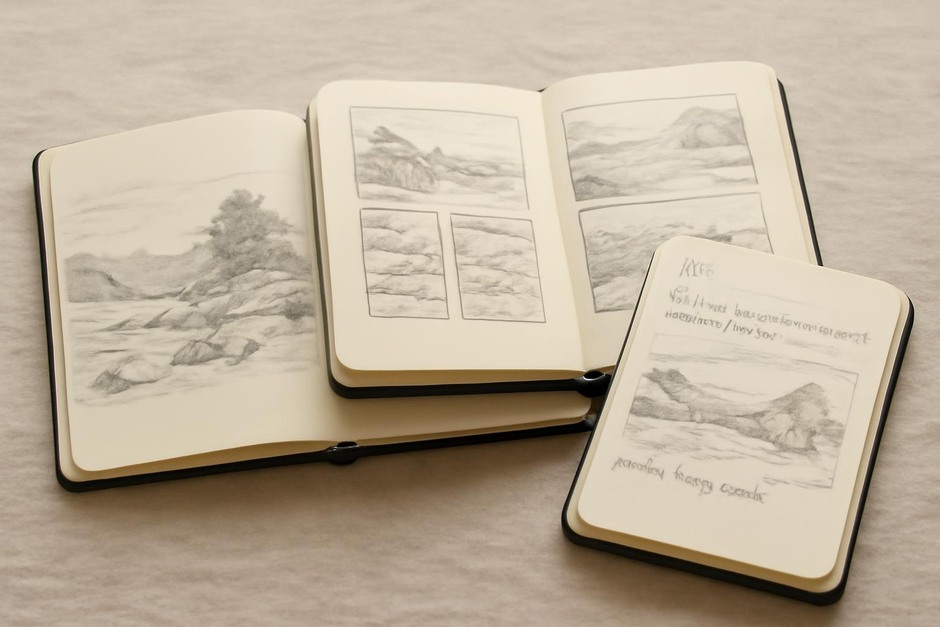
Adding text to drawings is not merely a convenience; it changes how a page reads and what it records. Short notes can supply colour information, timing, measurement, and the observer’s impression. The trick is to use words in a way that complements rather than competes with the image.
Types of notational marks
Different kinds of marks serve different functions. Consider three common categories:
- Descriptive labels — short phrases that name elements, such as “yellow ochre” or “east-facing wall.” Useful for later recall and for distinguishing similar forms.
- Measurement notes — simple ratios or short sighting results like “5:3” or “thumb = 2m.” These support accurate proportion and scale when you return to the page.
- Reflective comments — brief impressions or reminders, for example “warmer in shadow” or “flatten forms near roofline.” These notes capture decisions you might otherwise forget.
Shorthand systems
Some sketchers develop shorthand to keep writing minimal and fast. Abbreviations, symbols, or even a small legend at the front of a sketchbook can speed notation while keeping the page legible later. For instance, a simple symbol for sunlight, a dash for wind, or a two-letter abbreviation for a pigment can reduce interruption during observation.
Placement and hierarchy
Placement of text matters. Margins are natural places for longer notes, while small labels are often best placed near the element they describe. Consider using different weights or tools for hierarchy: a fine pen for labels, a pencil for quick measurements, and a darker marker for key reminders. This visual hierarchy helps when scanning pages later.
Exercises to practice text and image together
- Label experiment: On a single page, do three quick sketches of the same subject and label each with three descriptors—colour, temperature (warm/cool), and one measurement.
- Shorthand test: Create a two-page legend of five abbreviations or symbols and use them in the next ten sketches to see which feel natural.
- Reflective margin: After a thirty-minute study, write a one-sentence reflection in the margin about what surprised you and one change you would make on a second attempt.
Reading your notes later
When you return to a sketch, the combination of word and image often clarifies choices that were implicit at the time of making. Labels can turn a sketch into a reliable record for studio work, while reflective remarks guide future experiments. The aim is not to annotate everything but to use text to preserve what is otherwise fleeting.
Different systems suit different makers. Some readers prefer sparse labels; others rely on more extensive marginalia. Try several methods and notice which kind of notation helps you remember and act on what you saw.